Bag Order Sampling Timeline: What 12 Days Actually Covers
A handbag sample is not one job. It is five small jobs in sequence — material, cutting, sewing, hardware and photography — and the twelve working days buyers quote usually covers all five only when the material is already on the factory's rack. Knowing which of the five your change touches is the difference between a sample in your hands before the trade show and one that arrives after it.
What the twelve days are actually spent on
Break the window into its steps and the arithmetic stops being mysterious. A round that finishes in twelve working days is a round where every input was available on day one:
- Material pull: one to two days when the PU, canvas or leather is a colour the factory already stocks. A colour it does not stock is not a sampling delay, it is a tannery order, and those run in weeks.
- Pattern and cutting: one day against an existing pattern. A new silhouette needs a paper pattern drafted, a trial cut and a fit check, which is two to four days on its own.
- Sewing: one to two days for a single bag. A lined bag with piping, an internal zip pocket and a reinforced base takes the upper end; an unlined tote takes the lower.
- Hardware fitting: same day if the turn-lock, D-rings and feet are stock items. A custom plate with your logo engraved needs a die, and a die is a separate lead time.
- Photography and packing: one day, and worth insisting on — the photos are what you actually approve if the sample ships while you are still deciding.
- Courier: three to five working days on express. That is transit, not production, and it sits outside the twelve days in most quotes.

Add it up and the twelve days is really eight to ten days of factory work plus slack. That slack is the first thing a schedule eats when a colour swatch arrives late or a hardware item is out of stock.
Which changes fit inside twelve days
The useful question before you request a sample is not how long it takes, but which input your change adds. A colourway change on an existing style touches material only. A logo change touches tooling only. Both are short. A new silhouette touches pattern, cutting and sewing at once, and no amount of chasing compresses it.
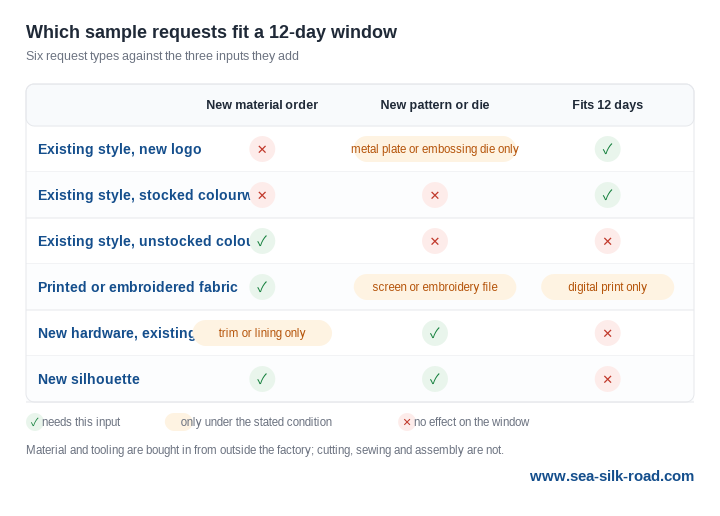
The pattern to notice is that material and tooling are the two inputs that arrive from outside the factory. Everything the factory does itself — cutting, sewing, assembly — is a matter of days. Everything it buys in is a matter of weeks, and the quote rarely says which one you are waiting for.
Where the window breaks
Four things push a sample past its date, and three of them are decided before the request is even sent.
A colour that is not in stock. The single most common cause. If the brief says "our brand green" and the factory's green is a different green, someone has to buy leather or PU to match, and that purchase has its own minimum. Ask for the stock colour card first and pick from it, or accept the extra weeks.
Custom hardware. A turn-lock, a magnetic closure or an engraved plate needs a mold or a die. Ask whether hardware can be borrowed from an existing style for the sample and tooled later for production — that keeps the sample on schedule and moves the tooling cost to a stage where it blocks nothing.
An unapproved logo file. Vector artwork with the right stroke weights takes minutes to place; a JPEG pulled from a website gets redrawn, and redrawing goes back and forth for days. Send vector art with the request, not after the photos.
A pattern that has never been sewn. First-time silhouettes almost always need a second round, because the first reveals that the gusset is too narrow or the strap drop is wrong on a real body. Budget two rounds for a new shape, one for an existing one.
What to put in the sample request
A request that gets a usable sample in one round reads like a work order, not an email. Six lines carry almost all of it:
- Style reference: the exact existing style code, or a dimensioned drawing for a new one.
- Material: name, weight or thickness, and a colour from the factory card, with a Pantone reference as a second check.
- Dimensions: length, height, depth and strap drop in millimetres, measured the way the QC sheet will measure them.
- Hardware: finish and type, and whether it must be the production item or a stand-in is acceptable.
- Logo: method, placement, size in millimetres, and vector artwork attached.
- What you will judge: the two or three things the sample exists to prove.
The last line is the one buyers skip. If the sample is meant to settle whether a 250mm depth reads as a tote or a weekender, say so — the factory will photograph it next to something for scale instead of against a white wall.
Approving it without a second round
Approval goes faster when the sample arrives with its own evidence. Ask for the weight in grams, the measurements recorded on the same sheet as the spec, and photos of the four places that fail first: the strap junction, the zip ends, the base corners and the lining seam. Handle the sample the way a customer will — fill it, close it, hang it by one strap — before you sign off, because a bag that photographs well and sags under load is a return, not an approval.
Then write the approval down. "Approved as received on this date, with these three deviations noted" is a sentence that ends arguments six weeks later, when a production run matches the sample in every way except the one nobody wrote down.
Send the style code, the stock colour you picked and the two things the sample has to prove, and the round can be scheduled against a date rather than a hope. Handbags and PU bags for bulk orders are quoted per project; request a sample and a quote with your quantity and target date.
Planning a promotional gift order?
Send your spec and target quantity for a quote and a digital proof.
Get a free quote


