Clutch Frames: Sewn vs Metal for Evening Bag Orders
An evening bag order is decided by the frame, and the frame is decided on the first sample. A sewn body with no frame buys flexibility and gives up shape. A metal kiss-lock frame buys a clean closure and inherits a gap tolerance measured in fractions of a millimetre, applied by hand to hundreds of pieces. A hinged box frame lets the bag stand open on a table and puts a frame supplier in the critical path of your delivery date. Getting this wrong does not cost you the frame price; it costs you a sorted, reworked or scrapped lining on the whole run.
What the Frame Decides Before Anything Else
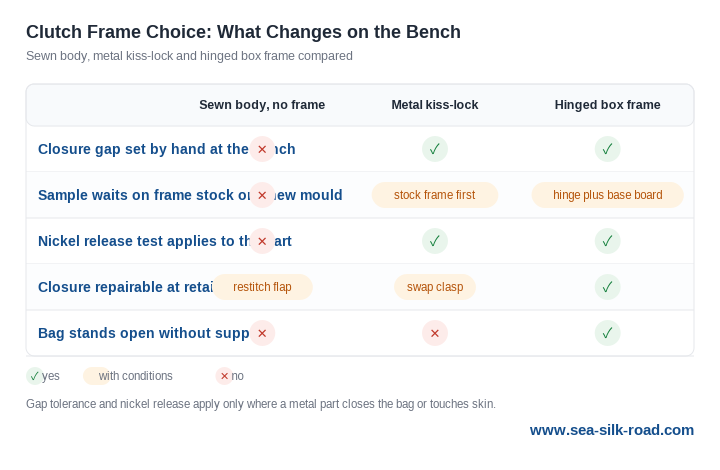
Three things follow from the frame choice, and all of them land after the deposit. First, where the bag fails in use: at the seam where a sewn flap meets the body, at the gap between two kiss-lock halves, or at the hinge pin. Second, whether a metal part sits against skin, which pulls the order into nickel release testing. Third, whether a failure can be repaired at retail or has to come back to the factory.
None of these appear on a price sheet. Ask for them in writing on the sample approval form, because the frame is the one component a buyer usually sees only as a finished, closed bag.
Sewn Body, No Frame
The body is stitched, turned and closed with a flap over a magnet or a snap. Tooling is the cheapest of the three options and there is no frame stock to wait for, so sampling runs on the lining and interfacing schedule instead. Shape comes from the interfacing, which means the bag holds its form when new and softens with use; that is acceptable for a soft envelope clutch and wrong for a bag that must look architectural on a display table.
The failure mode is the closure. A magnet stitched between lining and shell pulls through the lining after a few hundred openings, and the symptom is a small dimple that grows into a tear. Specify the magnet pocket as a separate stitched patch rather than a drop-in, and test by hanging the loaded bag from the flap for an hour. A flap that lifts away from the body under its own contents will do the same in a customer handbag.
Metal Kiss-Lock Frame: Gap Tolerance Is the Whole Order
A kiss-lock frame is two cast halves joined at a pivot, sewn or glued into the top edge of the body. The gap where the two halves meet is the quality signal a buyer feels before looking at anything else. Measure it with a feeler gauge at three points across the opening, on a closed bag, and write the tolerance on the order. Two pieces from the same batch should read the same; if they do not, the frame supplier is mixing cavities.

The lining is the second half of the problem. It has to be clipped into the frame channel, glued, and stitched through, and the three operations fight each other: too much glue and the channel bulges, too little and the lining pulls out at the corner within a season. Ask the factory which sequence it uses and whether the glue is applied by nozzle or by brush. A brushed channel on 500 pieces will show variation at the two ends of the frame, where the brush turns.
Metal against skin also brings a test. Under REACH, items with a metal part in prolonged contact with skin must meet a nickel release limit of 0.5 micrograms per square centimetre per week, measured by the EN 1811 method. The report has to name the frame supplier and the alloy, not just the finished bag, because a substituted frame in a later batch invalidates the document. If the frame is brass with a lacquer, ask what happens to the release figure when the lacquer wears at the pivot.
Hinged Box Frame: When the Bag Must Stand Open
A box frame adds a rigid base and a hinge, so the bag stands open and the interior becomes part of the product. That is worth the cost for a bag sold on a display table or used as a vanity case, and it is wasted on a flat clutch that lives in a handbag. The hinge pin is the wear point, and a replaceable pin with two screws is a repair a retailer can do; a riveted hinge means the bag returns to the factory.
Weight rises with the frame and the base board together, which changes the strap or chain specification. A chain sized for a soft clutch will cut into the shoulder on a framed bag. Re-check the chain pull test after the frame is added, not before.
Four Checks Before You Approve a Frame Sample
Gap under load. Measure the closure gap, load the bag with a phone and a card case, then measure again. A gap that opens under load will open wider in use.
Cycle the closure. Open and close the frame 200 times by hand, then re-measure the gap and look for lacquer wear at the pivot. Do this before the deposit, not after the bulk arrives.
Read the nickel report. Confirm the alloy and the supplier named on the test report match the frame on the sample. A report for a different alloy is a report for a different product.
Check the lining at the corners. Turn the bag inside out and look at both ends of the frame channel. Lining that is puckered when new will pull free once the leather relaxes.
What to Write on the Order
Frame type; frame supplier and alloy; closure gap with a tolerance and the gauge used; lining attachment sequence; nickel release report reference; hinge type and whether the pin is replaceable; and the loaded-bag drop height you will accept at inspection. Add the repair position: what the retailer may fix and what must come back.
Send the bag size, the closure you have in mind and the market you sell into. We will quote a sewn body, a kiss-lock and a box frame against the same artwork so the difference is visible before you commit, and ship frame samples for a gap and finish check. Browse the full clutch bag range for body shapes that suit each frame.
Planning a promotional gift order?
Send your spec and target quantity for a quote and a digital proof.
Get a free quote


