Bag and Gift Set Bundling: 3 Ways to Build a Corporate Box
A corporate box is not a pile of gifts in a carton. It is a budget divided into a few deliberate ratios, then packed so the items arrive in the order you intended. Start with the number you can defend per recipient, decide how much of it goes to the anchor item, and only then browse the catalogue. Three tiers cover most programmes, and the accessory ratio and carton fit decide whether the box feels considered or thrown together.
Build Around One Budget, Not a Shopping List
Set a landed cost per box before you choose a single SKU. That figure has to include the anchor item, the supporting pieces, the insert, the outer carton and the inbound freight, because a gift that looks modest on a product page can become expensive once its packaging and shipping volume are counted. Write the number down as a range with a hard ceiling. Every decision after that is a test of whether the mix still fits.
Work backwards from the ceiling. If the box must land under a certain figure, the anchor item can absorb roughly half to two thirds of it, the supporting items a quarter, and packaging and freight the remainder. Those proportions are a starting point, not a law: a fragile anchor may need more packaging, while a light, flat kit may ship cheaply and free budget for a better insert. The point is to make the split explicit so a late addition has to displace something rather than simply push the total over.
Tier 1: The Low-Cost Welcome Box
The entry tier is for scale: new hires, event attendees, or a mail-out where the message matters more than the object. Choose one useful, light item as the anchor and add two small companions that share a theme. A notebook, a pen and a luggage tag all speak to work or travel and pack flat, which keeps both carton volume and damage risk low. Skip the rigid box at this level. A printed header bag or a simple sleeve protects the contents and carries the branding without spending the budget on structure the recipient discards.
Keep the count of SKUs small. Two or three items are easier to source, inspect and pack than five, and a consistent kit survives a scale-up far better. If a companion item is out of stock, the whole box waits; fewer dependencies mean fewer delayed shipments.
Tier 2: The Mid-Range Client Box
Here the anchor becomes visible: a tote, a small leather item or a branded drinkware piece that the recipient will actually keep. Build the rest of the box around how that anchor is used. A bag pairs naturally with a notebook and a keychain; a desk item pairs with a pen and a mouse pad. The supporting pieces should explain the anchor rather than compete with it.

At this tier a foldable cardboard box with a printed insert is usually worth the cost. It turns a set of separate items into one gift, gives you a surface for a short message, and stacks more predictably in a carton. Confirm the box opening sequence: the recipient should see the anchor first, with the smaller items nested around it rather than hiding it.
Tier 3: The Premium Recognition Box
The top tier is for a small list where the box itself is part of the recognition. A rigid box with a lift-off lid, a fitted insert and a single high-quality anchor signals care before the contents are read. This is the tier where a magnetic closure, a foil-stamped name or a fabric divider earns its cost, because the audience is small enough that the per-unit difference is affordable.
Resist the urge to add items at this level. A premium box with three considered pieces reads as more valuable than one with seven mixed pieces, and a fitted insert only works when the item count is stable. Lock the SKU list before the insert is designed; changing one item after tooling means a new insert and a new sample round.
Accessory Ratio and Carton Fit
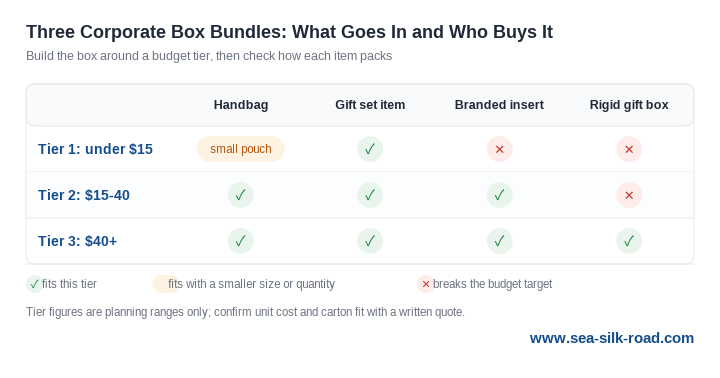
The matrix shows the pattern: tiers differ mainly in the anchor and the packaging, not in how many items go inside. Once the mix is set, check how it packs. Count how many complete boxes fit in a carton, whether the carton has void space that needs filler, and whether the heaviest item sits at the bottom. A box designed at a desk can fail in transit if the insert lets items shift. Ask for a packed-carton photo, not a photo of an open gift.
What to Confirm Before You Approve the Mix
Approve a physical sample of the full box, assembled in the intended order, with the final insert and outer carton. Check that the branded faces all point the same way when the lid opens, that no item rattles, and that the box survives a short drop from a packed height. Record the approved bill of materials with each SKU, quantity and packaging component, and attach it to the purchase order. A corporate box is a small assembly operation repeated hundreds of times; the only way to keep it consistent is to specify every part once and inspect against that list.
Ready to build a box that fits your budget and your list? Send the recipient count and a target per-box figure, and request a free sample and quote for a tiered proposal with the accessory ratio and carton fit spelled out.
Planning a promotional gift order?
Send your spec and target quantity for a quote and a digital proof.
Get a free quote


