Do Men Wallet Programmes Still Work in 2026? 4 Signals to Instrument
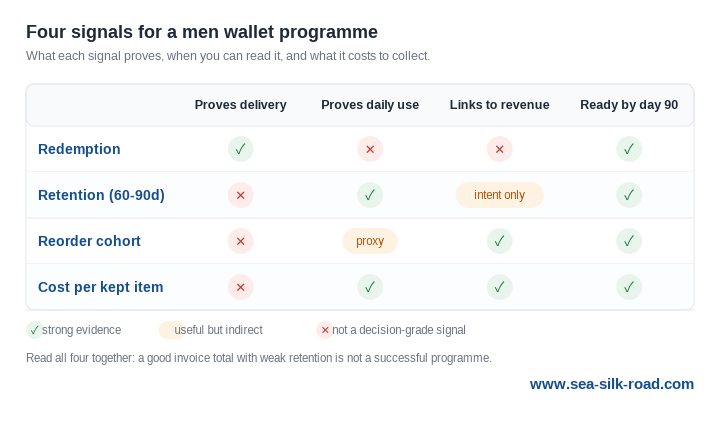
A men wallet programme does not fail because the wallet is wrong. It fails because nobody agreed, before the order, which number would prove it worked. If you cannot name that number now, you will spend December defending the spend instead of planning the next one. Four signals settle the question — redemption, retention, reorder and cost per kept item — and all four can be read from data you already collect.
1. Redemption: Did the Wallets Actually Reach a Person?
The first signal is the one most programmes skip. Shipping 2,000 wallets to a distributor is not the same as 2,000 people carrying one. Ask for a redemption or distribution record: a count of units handed to an end user, not units delivered to a warehouse. If the gift is mailed directly, that is your courier delivery confirmation minus returns. If it goes through a sales team or an event, request a simple sign-off sheet — a name, a date and a quantity — rather than trusting a shipment invoice. A programme with 60 percent confirmed redemption is not a failure; it is a programme you can now measure honestly. Without this number, every later signal is built on a denominator you invented. Set the redemption target before the order and put the tracking method in the brief, so the person holding the wallets knows what to record.
2. Retention: Is the Wallet Still in Use 90 Days Later?
Redemption proves delivery; retention proves the item earned a place. For a men wallet the honest proxy is a short follow-up: a one-question survey at 60 to 90 days, or a sales conversation that asks whether the recipient still carries it. You are not measuring nostalgia — you are testing whether the body, size and finish suit daily use. A wallet that is too bulky for a front pocket, or whose print flakes after a month, gets moved to a drawer and stops working as advertising. Track the reply rate and the share of yes answers separately: a high reply rate with weak yes answers tells you the follow-up is reaching people but the product choice is wrong. Keep the same question across programmes so the number is comparable year to year. Two practical details make the answer trustworthy. First, ask a closed question with a short scale — carried daily, sometimes, or not at all — rather than an open invitation to comment, which response rates will skew toward the dissatisfied. Second, reach the same channel you used to distribute the wallets: if a sales team handed them out, have that team ask on its next routine visit, not a separate email from an unknown address. A retention number collected this way is modest but real, and it tells you whether your next order should change the body, the finish or nothing at all.

3. Reorder: Did the Recipient Come Back Without Being Asked?
The strongest commercial signal is behaviour you did not prompt. In the 30 to 90 days after handout, look at the recipient cohort: did they place a repeat order, request a quote, or re-engage with a dormant account? Compare that rate with a similar group that received no wallet. You do not need a perfect experiment — a matched pair of customer lists, same region and same period, is enough to see whether the gift group moves. What you are testing is not whether the wallet caused a sale on its own; it is whether the programme kept your name in front of a buyer at the moment they had a need. Record the absolute number of reorders as well as the rate, so a small but high-value cohort is not dismissed as noise.
4. Cost Per Kept Item: The Number That Settles the Budget
The final signal converts the other three into money. Divide the fully landed programme cost — unit price, tooling, print, freight, duty and handling — by the number of wallets confirmed still in use at 90 days. That is your cost per kept item, and it is the only figure that compares fairly against a different gift or a different channel. A wallet that costs more per unit but stays in a pocket will often beat a cheaper item that is discarded, because the denominator is larger. Watch the hidden adders: individual polybags and gift boxes raise landed cost, while a bulk-packed drop into an event bag lowers it. If two programmes land within a few cents on this metric, choose the one with the better retention answer, not the lower invoice.
Putting the Four Signals to Work
Run the four signals as a short scorecard, not a research project. Agree the redemption method and the retention question at the ordering stage, pull the reorder cohort at day 90, and calculate cost per kept item once the answers are in. See our men wallets range for body and finish options before you lock the spec. Then set one threshold in advance — for example a target cost per kept item — and decide now what you will do if the programme clears it or misses it. A men wallet programme is cheap to instrument and expensive to guess at. Request a free sample and quote to build the next one around a number you can defend.
Planning a promotional gift order?
Send your spec and target quantity for a quote and a digital proof.
Get a free quote


