Briefcase Freight Consolidation: 5 Ways to Cut Per-Unit Cost
Freight is the line buyers forget until the quote arrives, and on a briefcase order it can add more per unit than the lining upgrade they argued about for a week. Consolidation is not one trick; it is five separate decisions about how cartons, SKUs and the booking date fit together. Get them right and the same briefcase lands for noticeably less without changing the leather, the hardware or the print.
What consolidation actually changes in a landed quote
Carriers charge less-than-container load freight by the greater of weight or volume, written as W/M, whichever produces the higher figure. A briefcase is comparatively heavy for its size, so weight usually sets the rate. Consolidation works by making each of those two numbers smaller per saleable unit, or by spreading a fixed cost over more units.
Two costs deserve attention first. The origin fixed fee, covering documentation, terminal handling and the export declaration, is charged once per shipment whatever its size. Adding units to the same booking divides that fee further. The second is dead space inside a carton: air that the carrier still bills for. Both are under the buyer's control before a container is booked, and neither needs a design change.
What consolidation does not do is remove transit time or customs formalities. Treat any claim of a fixed percentage saving as a prompt to check the arithmetic against the current tariff, not as a number to copy into a forecast.
Fill a shared container, then right-size the carton
If the order cannot fill a container on its own, a less-than-container load booking shares the box with other cargo and splits the base cost across shippers. The trade-off is extra handling at the origin warehouse and a longer consolidation window, so build a few days of slack into the delivery date. Ask the forwarder for the current W/M rate and the origin fixed fee as separate lines; a single all-in number hides where the saving sits.
The carton matters just as much. Briefcases are rigid and stack unevenly if the master carton is oversized. Match the carton internal dimensions to the folded product plus a modest cushion, then confirm how many cartons fit a pallet and how many pallets fit the container. Reducing a carton by a few centimetres can lift the pallet count without touching the product.

Group SKUs and move the booking off peak
Buyers who source several colours or logo variants often book each variant separately. Combining them into one shipment with a single packing list keeps the origin fee and the documentation cost to one charge, and it lets the warehouse build one pallet plan instead of several. The only precondition is that every SKU is ready on the same date; a single late colour can hold the whole booking.
Timing is the second lever. Carrier rates climb around holiday peaks and before the Lunar New Year factory shutdown, when capacity tightens. Booking two or three weeks earlier, or accepting a departure just outside the peak week, often costs less than expediting later. This is a scheduling decision, not a negotiation, and it is available to small and large orders alike.
Finally, compare the nearest viable load port rather than defaulting to the largest one. A shorter inland leg can offset a slightly higher ocean rate, but only for certain lanes, so request both quotes before deciding.
Which levers fit your order size
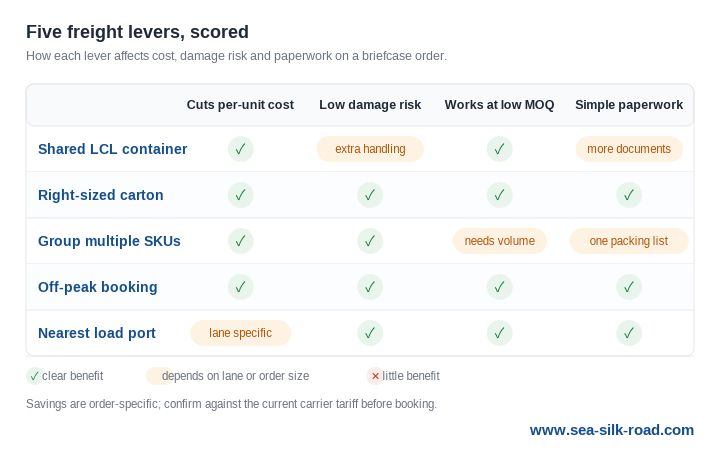
Not every lever pays off on every order. The matrix below scores each one against the four questions buyers ask most: whether it cuts cost per unit, whether it protects the product, whether it works at a modest minimum, and how much paperwork it adds.
A five-line check before you confirm the booking
Ask the forwarder to quote weight and volume separately, then verify which one sets the rate. Confirm the carton count per pallet and the pallet count per container, and challenge any carton that leaves more than a small gap around the folded product. Put all SKUs on one packing list with a single ready date. Pull the booking forward if the departure falls in a peak week. Compare two load ports on the inland leg.
None of these steps needs a supplier to change the product, which is why they are the first place to look when a landed cost feels high. Start with the wider briefcase range to see how case construction changes packed volume, then apply the checklist to the specific model you plan to order.
Send us the briefcase model, the order quantity and the destination port, and we will return the packed carton dimensions and pallet count so your forwarder can quote an accurate landed cost.
Planning a promotional gift order?
Send your spec and target quantity for a quote and a digital proof.
Get a free quote


