Handbag Compliance: REACH and Prop 65 Documents to Request
A handbag compliance file is not one certificate. It is a short set of test reports and declarations, one per material family, and the reason buyers get caught out is that REACH and Prop 65 do not ask the same question. REACH restricts what may be present in the article you place on the EU market. Prop 65 asks whether a chemical in the product creates an exposure that requires a warning in California. A supplier who sends a single REACH report and calls the file complete has answered one of the two, for one material, on one date.
What REACH Asks of a Bag, Article by Article
Two parts of REACH matter for sewn goods, and they arrive as separate documents.
The candidate list, usually called SVHC screening. This is a screening test for substances of very high concern above 0.1 percent by weight of the article. It is done per homogeneous material, not per product: the PU shell, the lining, the thread, the metal feet and the printed logo are separate articles in the legal sense, and a report that lists the bag as one sample without naming the materials is difficult to defend.
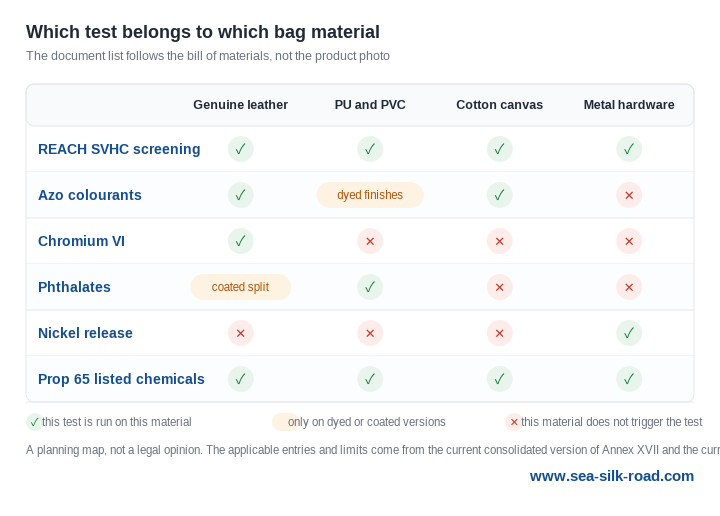
Annex XVII, the restricted substances list. This is where the numbers live, and they differ by material. Azo colourants are restricted in dyed textiles and dyed leather, and the usual test limit is 30 mg per kg for the summed aromatic amines. Chromium VI is a leather-specific entry, and the tanneries that still use chrome tanning are the reason it is tested: the limit is 3 mg per kg. Formaldehyde appears for textiles and for some coated materials. Phthalates are the plasticiser question, so they belong to soft PVC and to PU with a plasticised coating, not to cotton canvas. Nickel release is a metal-hardware entry, written for items in prolonged skin contact, which is exactly what a shoulder strap adjuster is.
The consequence: the document list follows the bill of materials. A canvas tote with no metal trim does not need a nickel release test; a PU bag with chrome-tanned leather trim and plated hardware needs all four.
What Prop 65 Asks, and Why It Is a Different Question
Prop 65 is a warning statute, not a substance ban. It maintains a list of chemicals, and a business selling into California must either avoid exposing consumers above the stated level or give a clear and reasonable warning. That is why the Prop 65 answer is often a documented exposure assessment plus a decision about the label, rather than a pass or fail sheet.
Three points are worth writing into the file. The list changes, so the report should say which version it was screened against. The short-form warning has a defined wording, and putting it on a hang tag is a decision to make before the tag artwork is signed. And lead in paint is not the same question as lead in a metal alloy, so a painted hardware sample and a cast hardware sample can give different results even when they look identical.
Who Issues Each Document
Two kinds of paper end up in a compliance file, and mixing them up is the most common reason a buyer thinks they are covered when they are not.
Test reports come from a laboratory, ideally one accredited to ISO/IEC 17025 for the specific method. A usable report names the sample material and colour, the method reference, the result against the limit, the date of receipt and the date of test, and the laboratory accreditation number. A one-page summary with a logo and a tick is not a test report, and a report that names the finished bag without naming the material cannot be traced back to a production lot.
Declarations of conformity are issued by the supplier, not by a laboratory. They are a legal statement that the goods meet the applicable restrictions, and they are worth as much as the test reports behind them. Ask for both, and ask for the declaration to reference the report numbers it relies on. Most of what buyers call certificates here are restrictions rather than certifications, so a supplier offering a certificate for azo dyes is usually selling a test report under a different name.
How Long a Report Stays Usable
Neither REACH nor Prop 65 puts an expiry date on a test report, which is why the question of validity is settled by the buyer, the retailer or the marketplace rather than by law. In practice most European retailers and marketplace compliance portals accept a report that is under twelve months old, and many will reject one that does not name the material and the colour.
What actually shortens the life of a report is change, not time. A new leather supplier, a new PU coating, a change of plating on the hardware, a different dye lot for a seasonal colour, or a factory move all break the link between the tested sample and the goods being shipped. The line to write into the purchase order is that any change of material source triggers a re-test on the affected material only, at supplier cost, with the report delivered before the first bulk shipment.
What to Put in the Purchase Order
The document list is worth one clause per material family, written before the sample is approved rather than after the cartons are packed.
Name the materials, not the product. List each homogeneous material with its colour, and put the test next to it. This is also the cheapest way to avoid over-testing: the clause tells the lab what to test, and it tells the supplier what they are paying for.
Fix who pays and who holds the samples. Testing is usually quoted per material per colour, so a four-material bag in two colours is eight lines, not one. Agree whether the supplier absorbs it on the first order and whether a retained sample of each material stays at the factory for the season.
Set the acceptance date, not the report date. Ask for reports issued within twelve months of the shipment date, and for the declaration to reference them by number. That single sentence removes the annual argument about whether last year file is still good.

Keep the file with the lot. File the report numbers against the production lot rather than in a shared drive, so a retailer query eighteen months later is a document reference instead of a search.
Send us the bill of materials with colours and the market you are selling into, and we will return the document list per material, the labs that can run it, and which lines you can drop because the material does not trigger them. That is a shorter list than most buyers expect, and a defensible one.
Planning a promotional gift order?
Send your spec and target quantity for a quote and a digital proof.
Get a free quote


