School Backpack Regulatory Map: REACH, Prop 65 and LFGB by Material
A school backpack does not pass one test. It passes a set of checks that follow the materials, and the file you hand the buyer changes with the shell fabric, the coating, the metal hardware and any food-contact compartment. Build the compliance map by component before you quote, because a test booked on the wrong material is a test you pay for twice.
Start From the Component List, Not the Finished Bag
Write down every distinct material in the bag: shell textile, PU or PVC coating, printed ink, foam lining, zipper tape, metal buckles and any insulated lunch pocket. A single finished-bag test rarely covers all of them. Buyers in the EU and California ask for different documents, so name the destination market on the same line as the component. A polyester shell and a PU-coated panel can travel under the same purchase order but need different declarations.
Ask the mill for the current test report on each material, not a certificate from a previous season. Reports age, coatings change and suppliers substitute an equivalent chemical without flagging it. Keep one retained sample per material so a later report can be tied to the exact stock you shipped. This discipline costs a few hours at sampling and saves a full container of rework when a buyer audits the file.
REACH, Prop 65 and LFGB: What Each One Actually Covers
REACH is the EU chemicals regulation; the part a bag buyer meets most often is the SVHC candidate list and the restriction on certain azo dyes and phthalates. Prop 65 is a California warning rule, so the question is whether a listed substance is present above its warning threshold and whether the product needs a label. LFGB is a German food-contact standard and only enters the picture when part of the bag touches food, typically an insulated lunch compartment or a water-bottle liner.
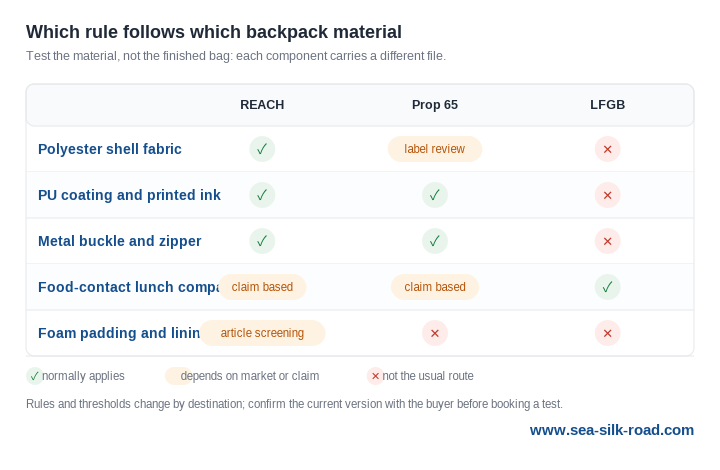
The matrix gives the starting route, not the final answer. A printed logo on the shell pulls the ink into the REACH check. A metal buckle with a decorative coating can trigger a Prop 65 review even when the base alloy is fine. An insulated pocket marketed as food-safe brings LFGB into scope, while the same pocket sold as a general storage compartment may not. Write the claim on the spec sheet so the lab tests to the claim you will actually make.
Material, Claim and Market Decide the Test Set
Three inputs set the file: material, marketing claim and destination market. Change any one and the checklist moves. A bag sold as ordinary school equipment in the EU follows one path; the same bag sold with a lunch-box claim in California follows another. Do not let a supplier book the cheapest single test and present it as full compliance. Ask for the test list in writing, with the standard number and the material it covers.

Keep the commercial side in view while you build the file. Stock bodies in the school backpack range are cheaper to sample because the mould already exists, and the factory usually holds current reports for the standard shell fabric. A custom coating or a novel laminate is where compliance cost climbs: you fund the test and you wait for the result. If a deadline is tight, choose the stock material with an existing report over a custom finish with a promise.
Build the File Buyers Can Audit
Put four documents in one folder: the component list, the current report for each material, the declaration or label that matches the destination market, and the retained sample log. Name files with the material and the report date so a buyer can see the version. When a buyer asks for compliance, send the folder rather than a single PDF and state which market each document serves.
Re-check the file at two moments: after sample approval and before the first production carton. Both are cheap windows to catch a substituted coating. If a report lapses between order and shipment, stop and update it rather than shipping on the old document. Compliance is a per-shipment obligation, not a one-time badge.
When you assemble the folder, number each report against a line on the component list so a buyer can trace a claim back to the material it covers. A pile of unlabeled PDFs invites questions and delays approval, while a short index that says which report answers which requirement reads as a controlled file. Keep the retained samples in dated bags with the same numbers. If a buyer ever challenges a declaration, the sample and the report together settle the question faster than an email exchange.
Next Step
Send us the component list, the destination market and any food-contact claim, and we will return the test set each material needs plus a school backpack built to that file. We will flag the components where a stock material already has a current report so your sampling budget goes to the parts that genuinely need testing.
Planning a promotional gift order?
Send your spec and target quantity for a quote and a digital proof.
Get a free quote


